Why House Clearance Recycling Matters
Managing a deceased estate often comes with a quiet, persistent worry about what happens to a lifetime of possessions. House clearance recycling is a major concern for most people in Cheltenham, who wonder if their parents’ carefully kept furniture will just get dumped in a skip. Does the word “recycled” actually mean something, or is it just a marketing line?
We understand that skepticism completely, which is why this family-run business, Coln Clearances, was founded in 2014 to provide reliable, respectful, and affordable services across Cheltenham.
“The latest 2025 data from DEFRA shows the national household recycling rate is stuck around 43.8%, proving that a lot of usable waste still ends up in the wrong place.”
Our daily operations are deliberately strict to ensure beloved items avoid the landfill. Where does cleared furniture go? We will break down exactly how this depot operates, explain the destination of different materials, and show you how this guaranteed 90% clearance landfill diversion rate works in practice.
The DEFRA Waste Hierarchy, in Plain English
The UK Environment Agency uses a formal “waste hierarchy” to dictate how materials should be handled. Government targets, like the push for a 65% municipal recycling rate by 2035 outlined in recent environmental legislation, rely heavily on this framework.
Our depot in Cheltenham is set up to work from the top down, following these priorities in exact order:
- Prevention (do not create waste in the first place)
- Reuse (clean and use again as-is)
- Recycling (break down for material recovery)
- Energy recovery (biomass, incineration with heat capture)
- Disposal (landfill)
Most rubbish clearance firms only work at the bottom of that hierarchy. They collect the items, dump them at a transfer station, and leave. We take a completely different approach by sorting every single load.
Where Your Items Actually Go
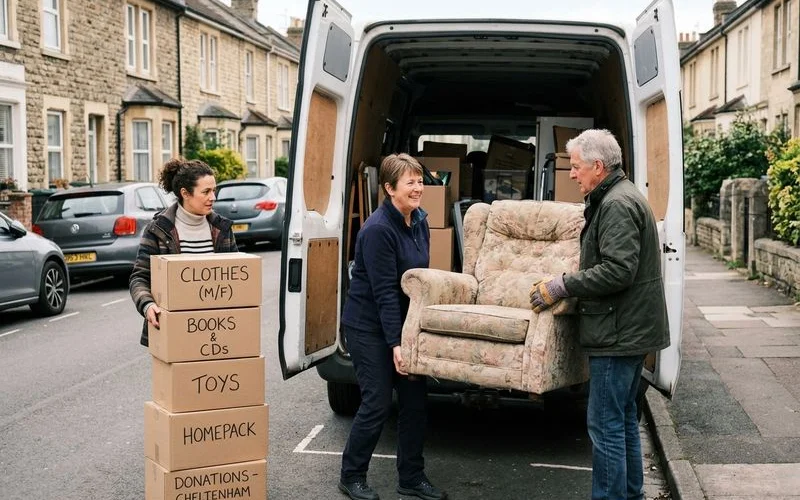
Here is exactly what happens after the vans leave your property and arrive at the Cheltenham sorting facility.
Tier 1: Reuse
Working furniture and household items that still have life in them are routed first to resale channels. This contributes directly to the cashback scheme we offer to offset your final bill. Where you have asked us to donate, these items go directly to local Cheltenham and Cotswold reuse charities.
We maintain active working relationships with several reuse organisations across Gloucestershire. A genuinely useful item will always find its way to someone who needs it rather than going to scrap. Our team takes pride in matching vintage Cotswold furniture with local community projects.
Tier 2: Recycling
Everything that cannot be reused as a whole item is sorted at the depot for material recovery. The recycling industry has changed significantly, and separating materials by grade is the only way to ensure they are actually processed.
We separate the following materials into dedicated streams:
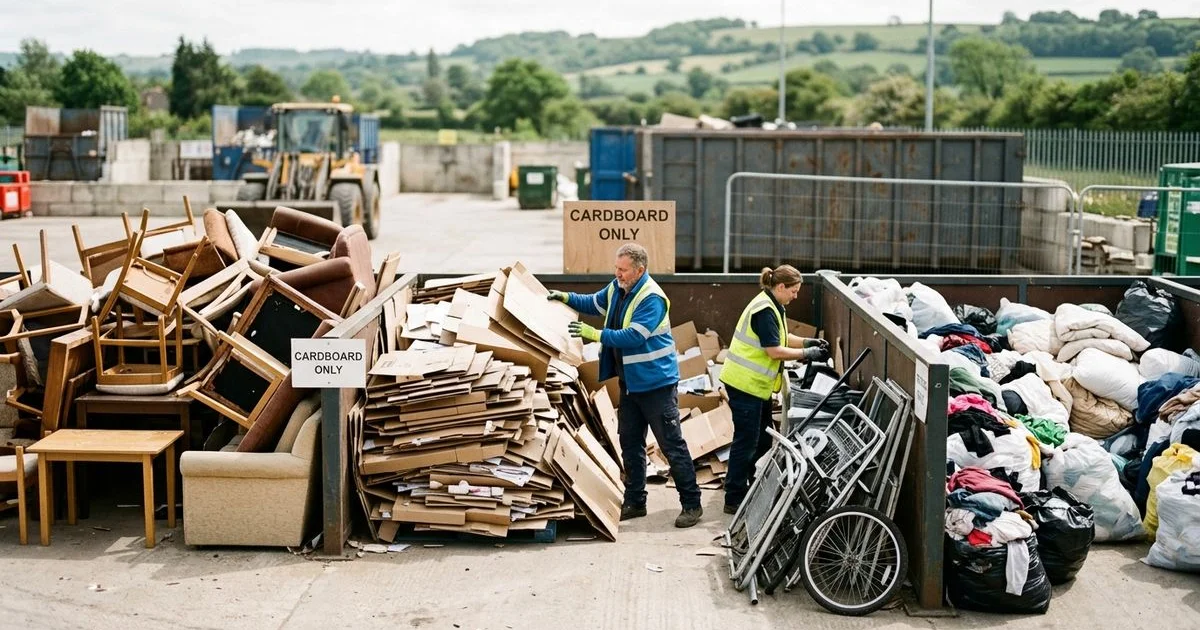
- Timber and wooden furniture: chipped for board manufacture or biomass energy
- Metals: separated by ferrous and non-ferrous, then sold to scrap recyclers
- Cardboard and paper: baled for paper recycling
- Textiles: sorted for the rag trade or recycled into industrial insulation
- Plastics: sorted by polymer grade where possible for reprocessing
- Glass: separated and sent to recovery facilities like Recresco in Wales
Tier 3: Specialist Streams
Some items require highly dedicated processing rather than general recycling. Old fridges and hazardous materials cannot just be tossed into a standard metal skip.
Our certifications ensure these difficult items are processed legally and safely:
- Mattresses: 100% components diverted, routing springs to metal, foam to insulation, covers to textiles, and slats to biomass
- WEEE (electricals): routed under the official WEEE certification (see Appliance & WEEE Disposal)
- Refrigerants: fridges and freezers drained of harmful gases by certified processors
- Hazardous items: paint, chemicals, batteries, and gas bottles sent to specialist licensed disposal facilities
Tier 4: Licensed Disposal
Less than 10% of what is collected actually ends up as landfill or general waste. National statistics from 2026 show that around 5.5% of all local authority collected waste in England still goes to landfill, so some final disposal is unavoidable.
We dispose of broken, contaminated, or otherwise non-recoverable items properly under a Licensed Waste Carrier permit. Waste transfer notes are always available on request to prove your items were handled legally.
The Mattress Story
Mattresses deserve a separate mention because they are the single most commonly landfilled bulky household item in the UK. Councils cannot easily recycle them, and skip firms often refuse to take certain types entirely. The Cheltenham Borough Council bulky waste collection fee for 2026 sits at £26 per unit, making local disposal expensive for a single bed.
We see the results of these high fees in the form of illegal fly-tipping across the Cotswolds. The National Bed Federation published its fifth End of Life Mattress Report in October 2025, revealing that while 56% of mattresses avoid landfill, the actual material recovery rate is still only 33% nationwide.
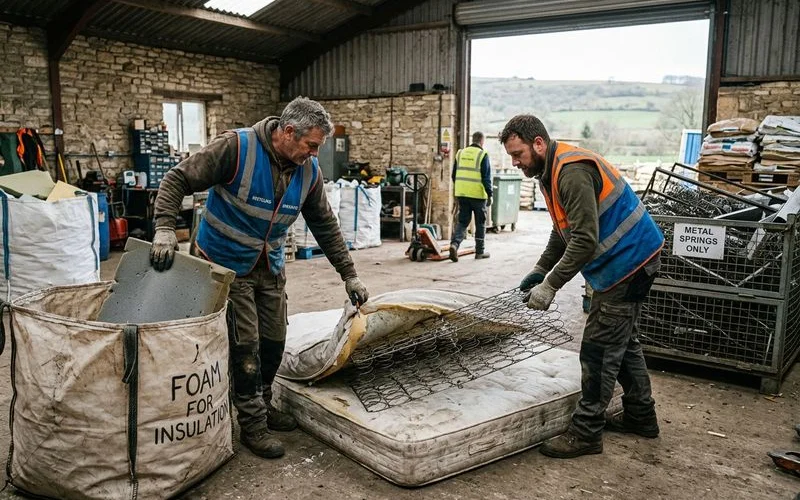
Our mattress recycling process beats that national average by routing 100% of the individual components.
- Steel springs and frames are sold to metal recyclers to be melted down
- Foam padding goes to insulation manufacturers or carpet underlay reprocessors
- Cover fabric goes to textile recycling for industrial cleaning cloths
- Wooden slats are chipped for biomass energy or board manufacture
Not a single mattress collected by this team goes to landfill.
Charity Routing, When You’d Rather Donate
Sometimes families have specific items they would rather see go to charity than to resale. This preference is especially common with probate clearances, where a piece of furniture belonged to someone the family wants to be remembered kindly.
We coordinate directly with reuse charities, children’s charities, and general support networks across Cheltenham. If you tell the team which items you want donated, those instructions are followed to the letter.
“Routing furniture to local charities provides a sense of comfort during a difficult time, ensuring a beloved item continues to be useful in the community.”
Our financial arrangement changes slightly when you choose this route. The value does not come off your quote as cashback, but instead becomes a straight donation to the selected organisation. Many families prefer the peace of mind that comes with this option.
Ninety Percent, Actually
The 90% recycling rate is not just an aspirational target. It is what the depot actually achieves week in and week out, and it is exactly what customers are told to expect.
We find that older Cotswold homes often contain a high volume of quality, solid wood furniture, which can push your personal diversion rate even higher. If a clearance is unusually full of heavily damaged or contaminated items, the rate might dip slightly.
Our standard approach provides a stark contrast to typical skip hire services.
| Feature | Standard Skip Hire | Coln Clearances 90% Process |
|---|---|---|
| Sorting Method | Everything mixed together | Items separated by material grade |
| Landfill Diversion | Varies wildly by provider | Guaranteed 90% floor |
| Usable Furniture | Often crushed | Routed to resale or charity |
| Mattresses | Frequently rejected | 100% components recycled |
That 90% figure is the baseline floor for how every single job is run.
Ready to Book?
If you want the peace of mind that comes with an eco house clearance and a genuine 90% house clearance recycling promise, please get a free quote or call 01242 830849. Ian will visit the property personally to assess the volume.
We will tell you honestly what will be resold, recycled, or donated from your specific property.